Tea in Ancient China: From Legend to the Classic of Tea
Every cup of tea in the world traces back to China. The plant grew wild in the hills of the south-west, and the Chinese were the first people to pick its leaves, boil them in water, and drink the result. The story begins in legend, with an emperor who tasted hundreds of herbs, and ends in history, with a book written in the Tang dynasty that turned tea drinking into an art studied, ranked, and argued over for the next thousand years.
In short
Tea drinking began in China. Legend credits the mythical emperor Shennong with discovering it around 2737 BCE, but the earliest physical evidence is tea found in the tomb of a Han emperor from the 2nd century BCE. Tea was first used as medicine, became a drink for pleasure under the Tang dynasty (618-907), and was given its first book, Lu Yu's Classic of Tea, written around 760 CE.
The legend of Shennong
Chinese tradition says tea was discovered by Shennong, the Divine Farmer, one of the mythical early rulers of China. The story goes that Shennong liked his drinking water boiled, and one day, while his servants boiled water on a journey, a leaf from a wild tea bush drifted into the pot. The water turned brown, Shennong tasted it, and found it refreshing. Lu Yu himself wrote in the Classic of Tea that tea as a beverage originated with Shennong. There is no archaeological trace of such an event, so this is tradition, not history — but it shows how old the Chinese believed tea to be.
A second legend says Shennong tasted hundreds of herbs and was poisoned many times a day, using tea as an antidote. Both stories agree on one point: tea's first use was medicinal, not social.
From medicine to drink
The earliest records fit that picture. China has the earliest records of tea drinking in the world, going back to the first millennium BCE. Under the Han dynasty (206 BCE-220 CE) tea was used as medicine. In 2016 archaeologists announced the earliest known physical evidence of tea: leaves of the genus Camellia found in the mausoleum of Emperor Jing of Han in Xi'an, showing that Han emperors drank tea as early as the 2nd century BCE.
By the 3rd century CE tea was being grown in Sichuan, and by the Jin dynasty (265-420) tea drinking had spread across the country. The first detailed description of tea drinking appears in a Chinese dictionary of about 350 CE. Tea was still often boiled with other plants, somewhere between medicine, food, and drink.
Lu Yu and the Classic of Tea
The turning point came in the Tang dynasty (618-907), one of China's golden ages. Tea drinking became an art, and its great moment was the publication of the first book ever written about tea: the Cha Jing, or Classic of Tea, by Lu Yu (733-804). Written around 760-762, it is the world's first treatise on tea, in three scrolls and ten chapters, covering where the plant grew, how to pick and process the leaves, the tools for making it, how to boil the water, and which regions produced the best tea.
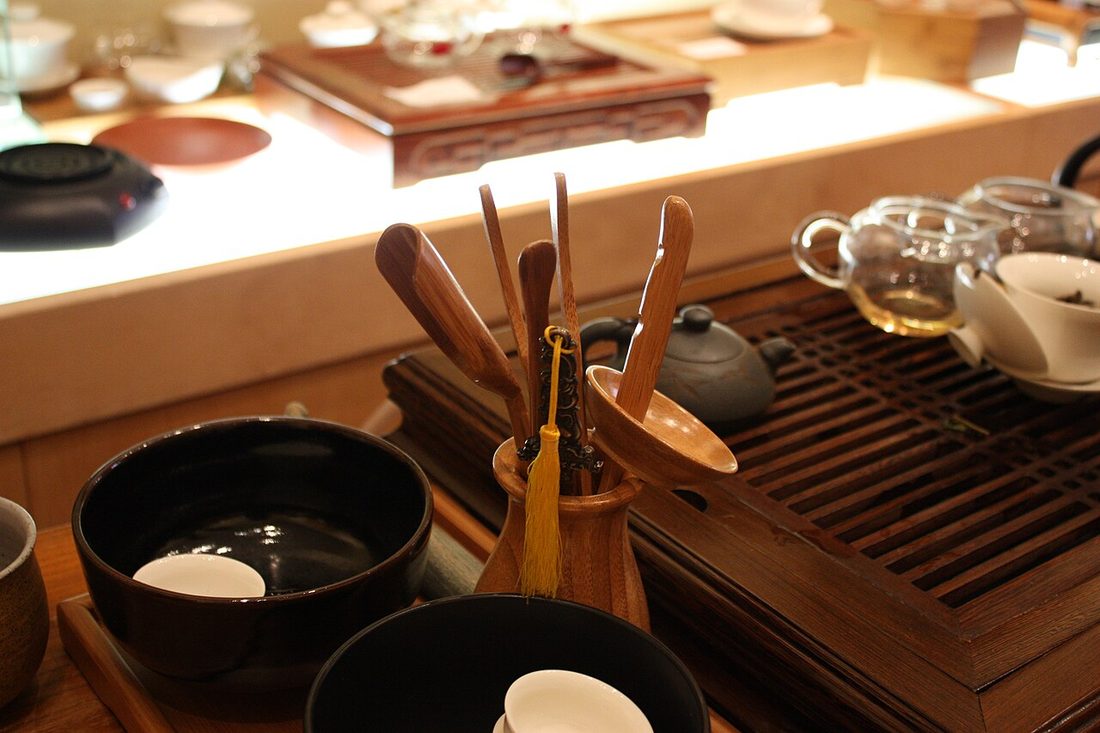
Under the Tang, tea was pressed into cakes, roasted, ground to powder, and boiled in a pot, sometimes with a pinch of salt. Lu Yu listed more than twenty implements needed to make it properly, and described the ritual of preparing it as a code of harmony and order. His book turned tea from a habit into a subject of knowledge, and it helped tea drinking spread to every part of China. In 770, a special office was opened on Mount Guzhu in Zhejiang province to produce tea for the imperial court.
How Tang tea changed
Under the Song dynasty that followed, fashion changed again: the pressed cake was ground into a fine powder and whisked with hot water into a froth, the style Japan would later keep as matcha. Then in 1391 the founder of the Ming dynasty ordered that only loose tea, in buds and leaves, be sent to court, and the modern way of steeping loose leaves took over. Each change kept the same plant and the same idea: a simple leaf, prepared with care, worth writing a book about.
Sources: Hangzhou Government, "Infused with history"; Asian Art Federation, "Tea Ceremony Traditions and Cultural Art"; Wikipedia, "History of tea in China" Checked 27 November 2026.